Non-transfer by design
Original files and databases remain in the enterprise environment.

ENTERPRISE AI DATA OPERATING SYSTEM
NEWELYS turns data already inside the enterprise into governed AI assets—connecting productization, rights, diligence, model evaluation, settlement and revocation in one operating system.
WHY NEWELYS
Enterprise data already exists. The challenge is making AI execution environments understand and enforce who may use it, for what purpose, within what scope, and for how long.
PLATFORM ARCHITECTURE
Installed connectors map location, hash, permission, and state metadata, while the policy engine governs productization, delivery, and audit as one continuous flow.
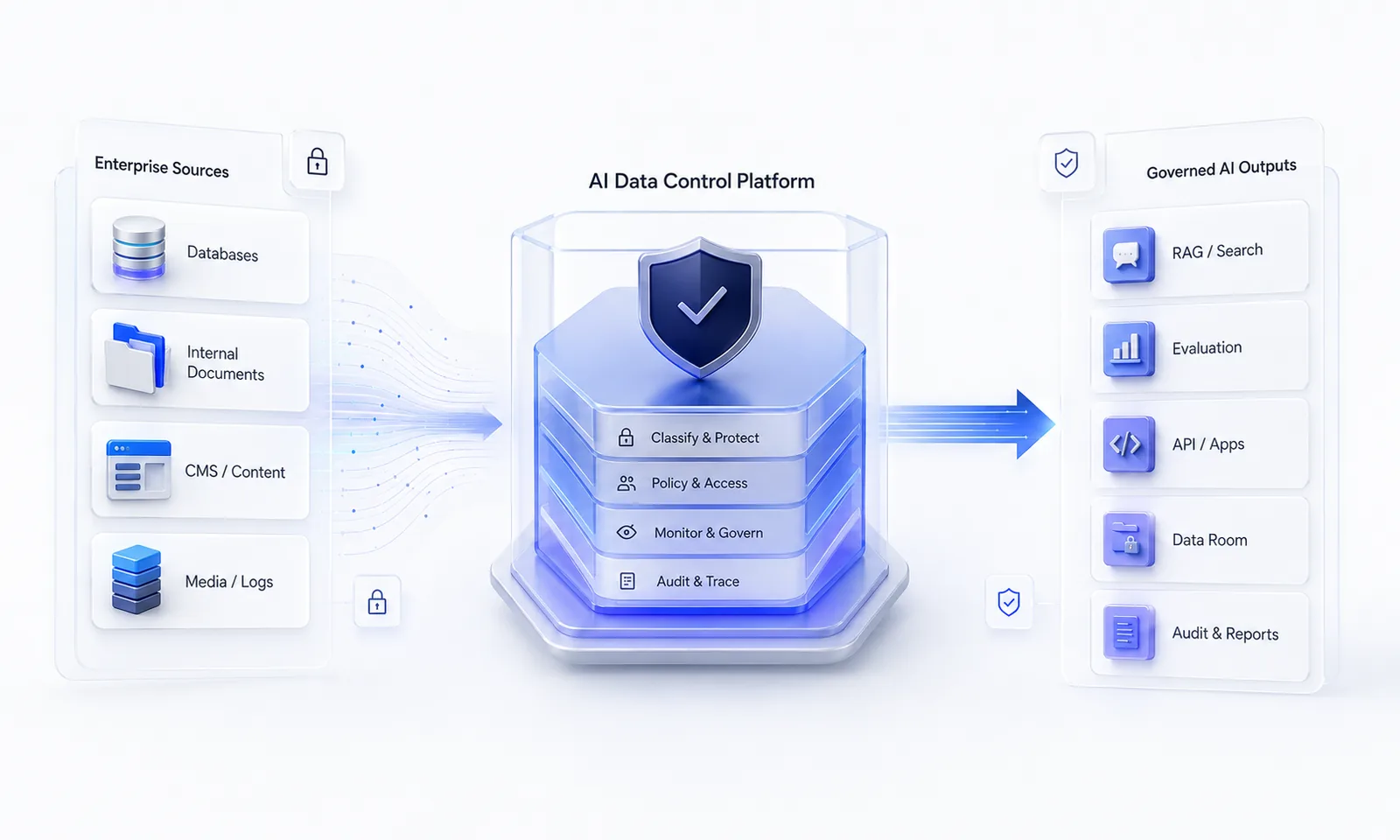
Original files and databases remain in the enterprise environment.
Reading, RAG, evaluation, training, download, and export rights are enforced separately.
Usage, changes, revocation, settlement, and reapproval remain auditable.
PLATFORM SUITE
Not a collection of point tools, but a control infrastructure between existing systems and AI runtimes.
Install local connectors across DB, DMS, CMS, file servers and APIs to connect only selected data.
Package scope, provenance, rights, quality, de-identification, pricing and state into a machine-readable product object.
Enforce RAG-only, eval-only, no-train and cleanroom-only conditions through tokens and runtime brokers.
Provide buyer diligence rooms and scorer-only model evaluation rooms without exposing source data.
Measure RAG, API and evaluation use plus evidence contribution to create settlement candidates and audit proof.
Synchronize rights changes and revocation across RAG indexes, APIs, caches, access grants and settlement states.
GOVERNED DELIVERY
Execution rights such as RAG-only, Eval-only, No-train, and No-download are enforced and revalidated at query time by user, organization, country, and time. Switch the purpose on the right to see how the same request resolves.
Explore the six core technologies ↗ENTERPRISE PROGRAMS
NEWELYS connects data, security, legal and AI teams from assessment and design through pilot and operational transition.
Build enterprise data inventory, rights and de-identification checks, manifests, catalogs and buyer rooms.
↘Implement enterprise RAG with query-time validation of department, role, project and purpose-based rights.
↘Design scorer-only evaluation systems that validate external models and APIs without exporting source data or labels.
↘Connect access tokens, usage snapshots, attribution, provider settlement and revocation into an operating process.
↘CORE TECHNOLOGY
INDUSTRY SYSTEMS
Combine industry-specific source units, ground truth structures, rights models and evaluation rules on a common platform.

Evidence, counterexample, refusal and uncertainty evaluation for public AI

Rights-bound data products protecting source content and answer keys

OCR ground truth, damage labels and scorer-only evaluation

Anonymous case data and evidence-based RAG evaluation

Enterprise RAG revalidating department, role and project rights

Image data rooms combining consent, de-identification and cleanroom controls

Turn POS, VOC and local-market data into permissioned analytical assets

Structure defect images, work orders and estimates into evaluation data
Deployment that keeps source and sensitive data inside organizational security boundaries.
Operate dedicated tenants, policy control planes and audit/settlement modules.
Role-specific operations for data, legal, security, privacy, AI and procurement teams.
Bind policies directly into RAG, evaluation, API and cleanroom execution paths.
ARCHITECTURE
Thirteen foundation systems and twenty execution controls create continuous technical boundaries from connection through revocation.
Connects local enterprise sources to a central control plane so selected data can be productized without replacing existing systems or moving source files.
Packages source references, scope, quality, de-identification, rights, price and state into a machine-readable product object while the original data stays in place.
Separates RAG, evaluation, training, fine-tuning, cleanroom, API, download and export rights, then enforces them inside the actual runtime.
Lets buyers review metadata, quality, de-identification, rights, safe samples and controlled trials without receiving the original payload.
Measures RAG, API, evaluation and cleanroom usage, connects evidence contribution to settlement, and propagates rights changes through audit-ready events.
Keeps source data and ground truth inside a scorer-only environment, runs buyer models under restriction, and exports only approved metrics and redacted error summaries.
Compares declared intent with real API, SDK, job and data-sink signals to enforce RAG, evaluation and training restrictions at runtime.
Propagates rights withdrawal, contract expiry and de-identification changes to vector indexes, APIs, caches, embeddings, samples and access credentials, blocking residual use.